
Reviewed and updated: October 30, 2026
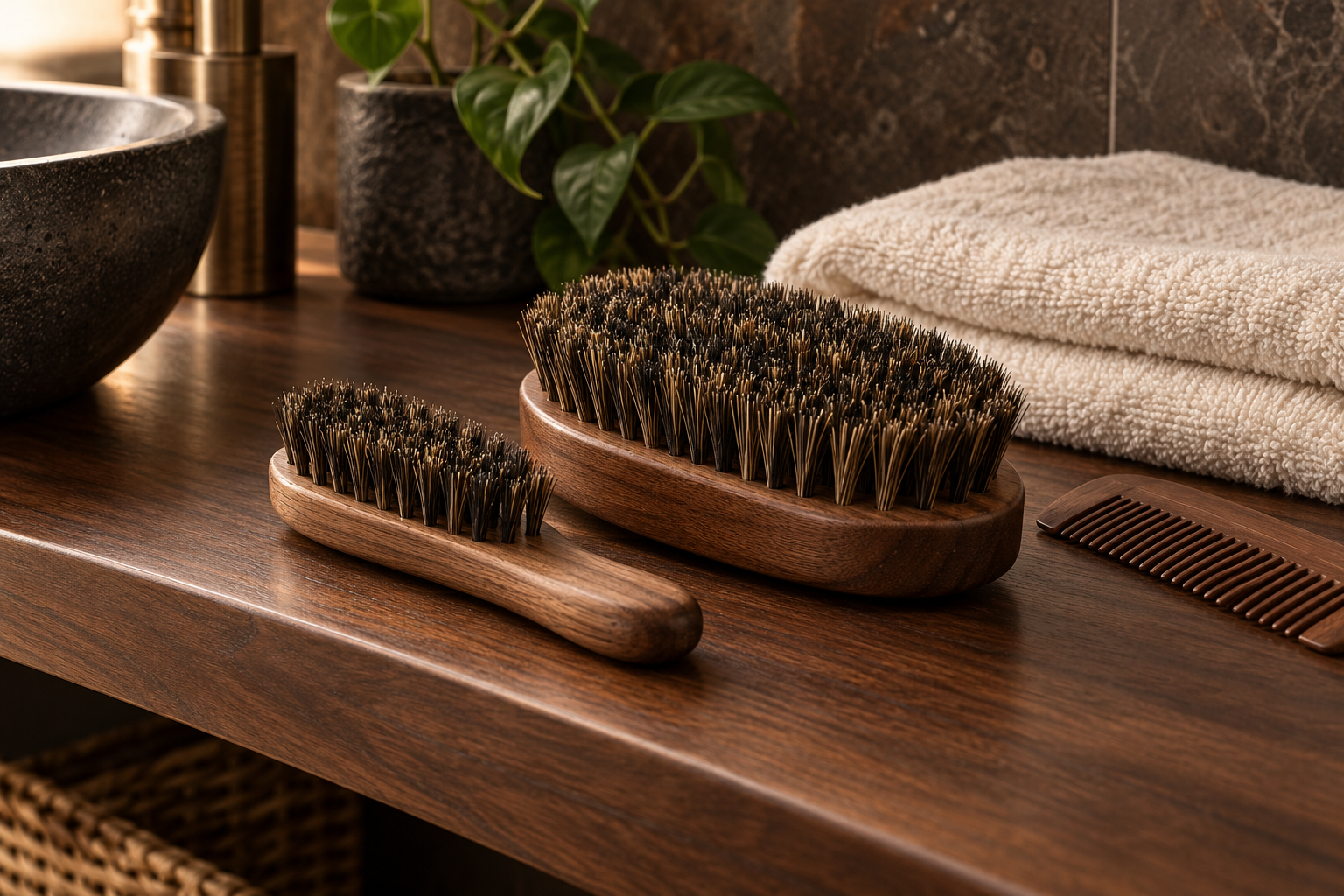
Kent's BRD2 and BRD5 are both handled beard brushes, but their proportions and bristle materials make them different buying decisions. Choose between them by the area you need to reach, the amount of hair you want to guide, and how the handle sits in your hand. A larger brush is not automatically a better brush, and a firm brushing sensation is not evidence that a tool is working more effectively.
This comparison uses Kent's current product descriptions to explain the two models. It does not claim a hands-on durability test or a universal winner. Start with the beard you have today, including awkward areas around the mouth and jaw, rather than buying for a beard length you might eventually grow.
Compare the options
Kent BRD2 Wooden Right Handed Beard Brush
The narrow, right-handed model uses shaped boar bristles. Compare its dimensions, handedness, and care requirements with your current routine.
Kent BRD5 Men’s Large Monster Beard Brush
The broader Monster model uses a horsehair-and-nylon blend. Check head size, material preference, and handling before choosing.
What the BRD2 actually offers
Kent identifies the BRD2 as its Wooden Right Handed Beard Brush. The official description specifies shaped boar bristles and an overall length of approximately 160 millimeters, with a 95-millimeter handle and a width of 20 millimeters. These measurements describe a relatively narrow tool. Kent also lists a separate left-handed version, the BRD3, so handedness should be checked rather than assumed from a product photograph.
In practical terms, a narrow head gives you a smaller area to position around the mustache or the edge of a short beard. That can be useful when a broad head contacts the lip or cheek before its bristles reach the hair you intended to move. It still requires a light touch. A small head does not make repeated scraping over the same patch comfortable or necessary.
What changes with the BRD5 Monster
Kent's Men's Large Monster Beard Brush carries the BRD5 model name. The manufacturer specifies a horsehair-and-nylon blend, an overall length of approximately 200 millimeters, a 100-millimeter handle, and a width of 53 millimeters. The material difference matters if you prefer or avoid a particular animal-derived bristle. Neither model should be described as animal-free.
The broader head is the more obvious distinction when planning your routine. It can cover a wider section of beard during one pass, while taking more room around narrow facial contours and in a travel pouch. Compare the listed dimensions with your existing brush or a paper outline on the counter. That simple size check is more informative than a close-up photograph with no scale.
Match the head to the work you need done
Think about your usual problem area. If it is a small section near the corner of the mouth, control and access may matter more than coverage. If it is the broad outer surface of a longer beard, a larger head may feel easier to position. Neither choice guarantees that it will pass through a dense knot or reach every layer of curly hair without resistance.
Separate detangling from final surface grooming. Work through an actual tangle gently with an appropriate tool and stop when it pulls. A brush should not be used to force a knot down the length of the hair. Our guide to choosing a beard comb by length and texture explains where a comb can fit into that sequence without turning brushing into a contest of pressure.
Check the grip before choosing by appearance
A handle that looks attractive in a gift box may not suit your wrist or usual direction of brushing. Imagine the movement from the sideburn toward the jaw and then around the chin. Check whether the handle leaves enough clearance for your fingers, and whether you would need to twist your wrist to keep the head where you want it.
Handedness deserves particular attention with the BRD2 because it is part of the official model identity. If you normally groom with the other hand, compare the appropriate alternative rather than assuming that any handled brush is symmetrical. For a gift, discreetly check the recipient's preference or choose a purchase arrangement that allows a straightforward return under the seller's current terms.
Use a short, gentle brushing routine
Start with a beard that is free of obvious tangles. Position the head against a small section and move in the direction you want the hair to lie, using only enough contact to guide it. Lift the brush between passes instead of repeatedly dragging it over the same area. If the skin becomes irritated or hair catches, stop and reassess the tool and technique.
Do not keep brushing simply because one stubborn strand remains visible. Texture, growth direction, a recent wash, and the way hair dries all affect the result. A brush cannot substitute for a suitable trim or careful drying. If your beard becomes rough after washing, review how to dry a beard without frizz before assuming that another brush will solve the problem.
Compare cleaning and storage requirements
Read the care guidance supplied with the exact brush you buy. Remove loose hair without digging into the bristle bed, and avoid soaking a wooden handle unless the manufacturer's instructions explicitly allow it. Do not assume that a cleaning method for a plastic comb is suitable for wood, natural bristles, or a mixed-bristle head.
Allow a cleaned brush to dry as directed before putting it into a closed pouch. Keep it away from a wet shower ledge or a puddle around the sink. If you use grooming products, avoid letting residue accumulate until it is difficult to remove. Inspect the head for damage or loose material, and stop using a brush that has become uncomfortable or cannot be cleaned appropriately.
Read an Amazon result as a model check
The Amazon actions in this guide open searches using the complete model names. Compare the listing title, photographs, model code, material description, and package contents before deciding. A result for BRD3, BRD6, a comb-and-brush set, or a similarly shaped unbranded tool is not the same recommendation merely because it appears beside the desired model.
We do not quote Amazon prices, availability, ratings, or delivery promises here. Review the current seller's terms and the actual listing you select. If the model identity remains unclear, leave that listing rather than trying to infer the product from a small thumbnail. Buying the wrong size or handed version undermines an otherwise sensible comparison.
Which one makes more sense?
The BRD2 is the narrower right-handed option to examine when precise placement is your priority and boar bristles suit your preferences. The BRD5 is the broader option to consider when coverage matters more and its horsehair-and-nylon blend meets your requirements. Both decisions should remain conditional on fit, comfort, care instructions, and a clearly identified current listing.
Before ordering, write down your preferred head width, handedness, bristle preference, and storage space. If neither model meets those needs, keep looking rather than choosing whichever name sounds more substantial. A useful beard brush earns its place by fitting a repeatable, comfortable routine with a light touch.